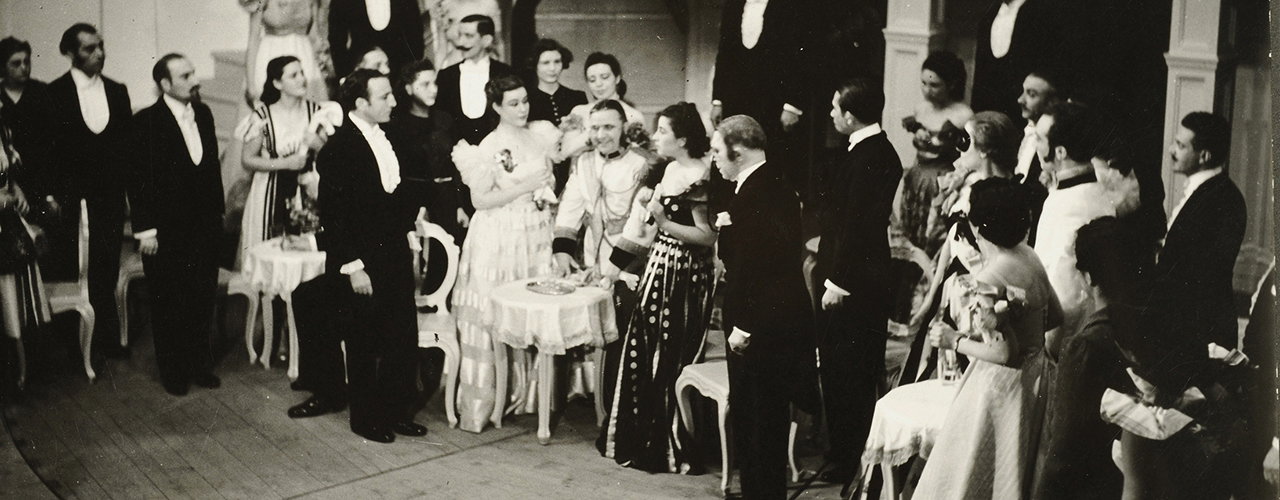
Initially, the newly formed troupe operated as part of the Royal Theater, staging performances on the stage of the neoclassical Theater of Schiller on Agios Konstantinos Street. From the very beginning, operetta and dance were cultivated alongside opera. Combining these three art forms, the operetta *Die Fledermaus* was chosen as the inaugural production. Giacomo Puccini’s *Madama Butterfly* was chosen as the first opera. It was with this troupe that the young Maria Kalogeropoulou (Callas) took her first artistic steps, performing leading roles in operas such as Puccini’s *Tosca*, Ludwig van Beethoven’s *Fidelio*, *The Plain* by D’Albert, and *The Master Builder* by Manolis Kalomiris.
In 1944, before the Liberation, the troupe became autonomous and began its independent journey as a public-law entity under the name National Opera of Greece, based at the first Olympia Theater onAkadimias Street. The opera *Rea* by the Corfu-born composer Spyridon-Filiskos Samaras was chosen as the inaugural production. The composer Manolis Kalomiris served as the organization’s first director.
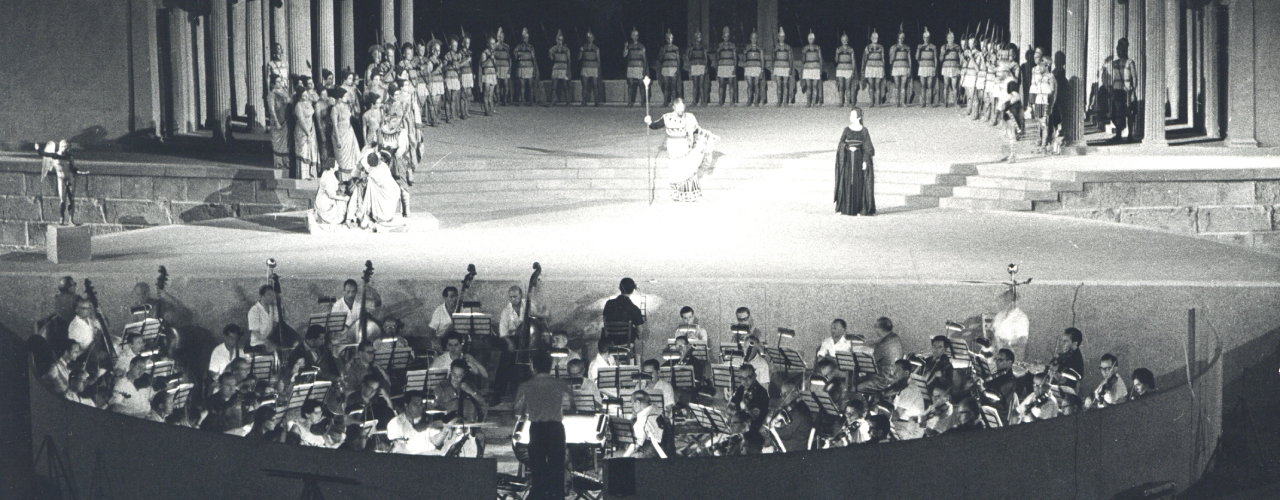
In 1958, the current Olympia Theater was inaugurated on the same site as the older one, with a performance of Giuseppe Verdi’s *Aida *. A period of prosperity followed, during which the organization’s repertoire expanded significantly, guided by its educational mission and an approach consistent with today’s understanding of cultural management. Each artistic season included approximately 20 productions, while a total of about 30 works were premiered, covering all eras, from the Baroque to contemporary works, and all schools of music—from the Italian, French, and German schools to the national schools of Eastern Europe and works by Greek composers. Notable performances took place at the Herodes Atticus Odeon and the Ancient Theater of Epidaurus, starring Maria Callas.
This highly successful artistic trajectory was interrupted by the imposition of military rule in 1967. During the seven years that followed, the Greek National Opera inaugurated its annual regular season in Thessaloniki, during which it presented nearly the entire repertoire of each artistic season. After the restoration of democracy in 1974, a new generation of Greek artists was invited to join the theater, infusing it with new vitality. During the difficult years of the post-dictatorship transition, the GNO was led by capable directors who supported it so that, despite economic and institutional challenges, its growth and artistic work could be ensured. The transformation of the GNO into a legal entity under private law (1994) enabled its further development. Gradually, co-productions with major foreign theaters began, a policy that expanded significantly after 2000. The parallel, substantial expansion of the repertoire was followed by an even greater enhancement of the productions and the organization’s international visibility, while its outreach through various initiatives across the country helped expand its audience.
On February 23, 2017, the Stavros Niarchos Foundation Cultural Center, which includes the new home of the Greek National Opera, was handed over to the Greek government. The company’s first performances at both venues—the Stavros Niarchos Hall and the Alternative Stage—took place during the trial season in the spring of 2017.